
A single greeting at the right moment can change the course of events. At Millbury National Bank, that simple act once discouraged a robbery. This small, long-standing institution in Massachusetts blends tradition, personal connection, and practical strategy in a way that continues to stand out in modern banking.
In the mid-2000s, a man entered Millbury National Bank with the intent to rob it. Instead of finding an easy target, he encountered a teller who greeted him warmly and even offered help with the briefcase he was struggling to manage. That unexpected interaction disrupted his plan.
He left the bank without incident. Later, authorities revealed that the same individual had gone on to rob another nearby bank. The situation only came to light when police arrived and asked if anyone had seen him. The teller provided a detailed description, aided by surveillance footage showing the suspect had been observing the bank since the previous day.
Chairman Kate Marcum, who served as CEO at the time, shared that greeting every customer is standard practice. Most visitors are recognized by name. This habit strengthens relationships while quietly acting as a layer of security.
A Bank Older Than Federal Oversight
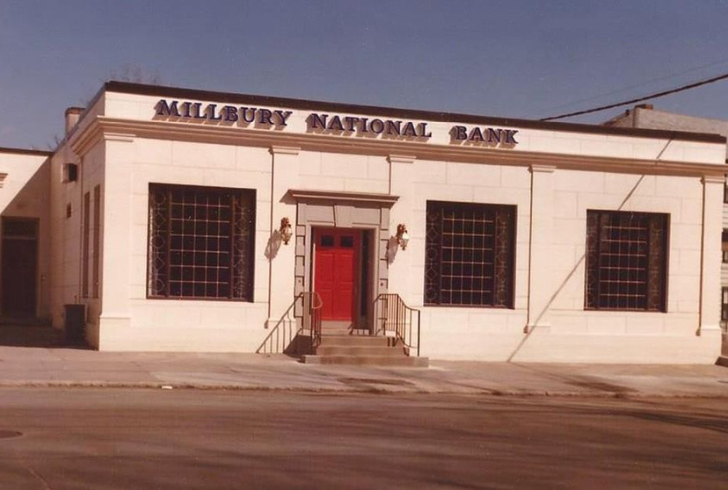
Instagram | @millburynationalbank | Millbury National Bank builds safety and trust by greeting every customer and creating strong personal connections.
Millbury National Bank has operated for over 201 years, holding approximately $140 million in assets. Its history dates back to 1825, when Asa Waters II founded the institution after struggling to secure funding for his gun factory. When traditional banks declined, he created his own.
That origin story remains visible today. Firearms are still displayed inside the bank, often surprising examiners. The institution predates the Office of the Comptroller of the Currency, placing it among the oldest banks in the United States.
The bank has never moved far. It opened on the same street where it still stands and has operated from its current building since 1924. Customers today walk through the same entrance used during the bank run that preceded the Great Depression.
Surviving Economic Shocks with Support
After the financial crash of the 1930s, then-president E. Paul Harris—Marcum’s grandfather—took direct action. He went door-to-door, asking community members to invest in the bank.
That effort successfully recapitalized the institution. According to Marcum, “That’s how he did it.” The approach reflected a deep reliance on local trust, a theme that continues today.
Ownership remains concentrated among about 50 shareholders, many from families connected to the bank for generations. Leadership follows a similar pattern. Marcum joined 33 years ago while her father was CEO. Today, her sister Suzanne Nydam serves as CFO, and her daughter Ashley Mathers holds the role of vice president.
More than half of the bank is owned by women. This ownership structure led to its designation as a minority depository institution in 2023.
The decision to pursue that status came during a period when deposits were declining. Larger banks and fintech companies were attracting customers with high-yield offerings. Instead of raising funding costs, Millbury National explored alternative strategies.
Marcum explained, “When deposits were running out the door, and all banks were looking at how they’re going to get deposits without increasing their cost of funds, we found this way.”
Adapting Without Losing Identity
For over two decades, the bank operated two branches, including one in Grafton located about four miles away. When the Grafton branch closed in September 2019, customers initially expressed concern.
That reaction shifted after the bank hosted a gathering that introduced Grafton customers to the main office team. The transition proved seamless. Not a single customer was lost.
The closure allowed the bank to redirect funds into digital upgrades, including enhanced online services and a new core system. These changes became critical just months later when the COVID-19 pandemic disrupted in-person banking.
Building Loyalty Through Life Events
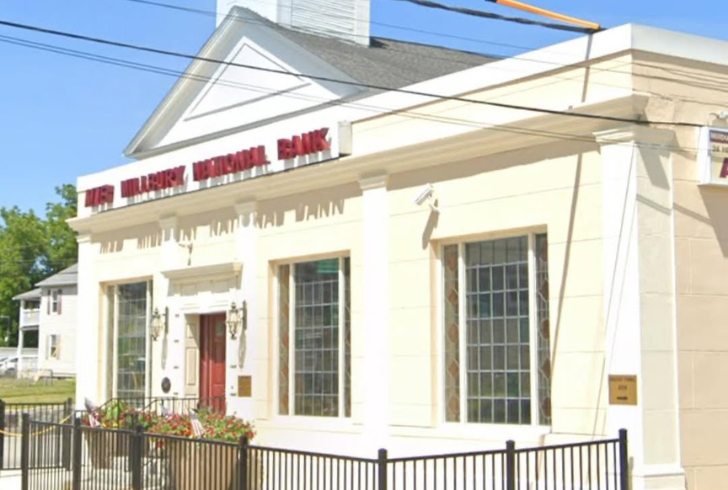
Instagram | @manchaugfirst | Millbury National Bank stays independent and successful by focusing on strong leadership and loyal community customers.
Customer relationships extend beyond transactions. Many clients have multi-generational ties to the bank, mirroring its leadership structure.
Ashley Mathers noted that the bank pays close attention to personal milestones. “We do a really good job at remembering and recognizing life events that people are going through, whether they’re good or bad,” she said.
That involvement includes attending funerals and wakes. Marcum added, “We go to the funerals. We go to the wakes, because we’re part of their family, and it makes a difference. People remember.”
This level of engagement creates lasting loyalty that goes beyond typical banking services.
Choosing Independence in a Consolidating Industry
While many small banks are being acquired, Millbury National has chosen a different path. Independence remains a central focus of its long-term strategy.
The bank actively plans for leadership and ownership transitions to maintain continuity. Marcum emphasized that offers to acquire the bank have been made, but none have been accepted.
“We’ve certainly had offers, but we’re just not interested,” she said. “People say you have to have a certain-sized bank. We don't find that. We're able to make money. We're profitable. We have good exams, and we get good feedback from the OCC, from our peers.”
Millbury National Bank presents a rare example of stability shaped by personal connection and careful decision-making. Its history spans economic downturns, industry shifts, and changing customer expectations. Yet, it continues to rely on simple practices—like greeting customers by name—that deliver both trust and unexpected security benefits.
The bank’s approach shows that longevity in finance does not depend on size alone. Consistency, local engagement, and thoughtful adaptation can sustain an institution across centuries while keeping its identity intact.